Tuesday, May 24, 2016

Katies First Carp

 
When my wife asked if we should go to a hot springs near Hagerman for our one year anniversary, I excitedly said yes. All I could think about was all the fishing opportunities that abounded in that area. I also realized that if I didn't want to be in the dog house, I better come up with some non-fishing ideas of things to do and see. The Hagerman area has no shortage of sights to see; a hike into Box Canyon, a trek across the Malad Gorge, a trip to the alligator farm and a visit to Shoshone Falls would occupy enough of our time so I wasn't tempted to fish the entire time. With the perfect plan in place, we headed off to Hagerman!
 
We checked into the Billingsley Creek Lodge and headed off to our first destination: Box Canyon.
"Honey, you don't mind if I pack my fly rod and make a couple casts when we get to the water, do you?" I said, with an innocent look on my face.
"No, that's fine!" Katie replied lovingly.
Crystal clear spring water, flowing into the Snake River, how could one not at least try to fish a little!
 
 
Box Canyon was definitely a pretty place. The water was gorgeous and the trail was easy; minus the botanical hazards of course!


Poison Ivy and Stinging Nettle reminded us the importance of staying on the trail.
We reached the famed waterfall, took a moment to enjoy it's beauty and then it was time to find out what lurked in the cold, blue waters.
 
Immediately I found small trout chasing my flies and I picked up a few in a short amount of time. The water looked like it might hold some monster trout, and I'm sure it did, but the "doinks" were all that were willing to play.
 
 
I fished for 15 minutes or so and decided that was enough. It was time to move onto our next destination: the Malad Gorge.
 
The Malad River Gorge was a neat sight to see. Crossing the high bridge and staring down into Devil's Washbowl could make even a roller coaster repairman queazy. We hiked a ways downstream on the canyon edge before turning around and heading to the car. No fishing to be done here! We had planned to go to the hot springs that night, but found out they were closed. Thus concluded our 'touristy' first day in Hagerman.
 
The following day we decided to begin with a trip to see the alligators. Fourteen and seven foot long gators are a strange sight to see in Idaho, but only in Hagerman!
 
 
The alligators were close to one of my favorite carp fishing spots and Katie was eager to try to catch one. She had fished for carp with me before but had never gotten one. I had high hopes for this spot and this day, so we rigged up the fly rods and snuck our way down to the river. We walked along an overgrown trail following a small creek. 
We emerged from the "jungle" next to the Snake River, and basking in the sun was a pod of nearly 50 carp. All ranging in size from 2 to 20 pounds. We took great care to be stealthy as Katie got into position.  Carp are spooky fish and all it takes is one fish to see you and they all blow out of the area.
 
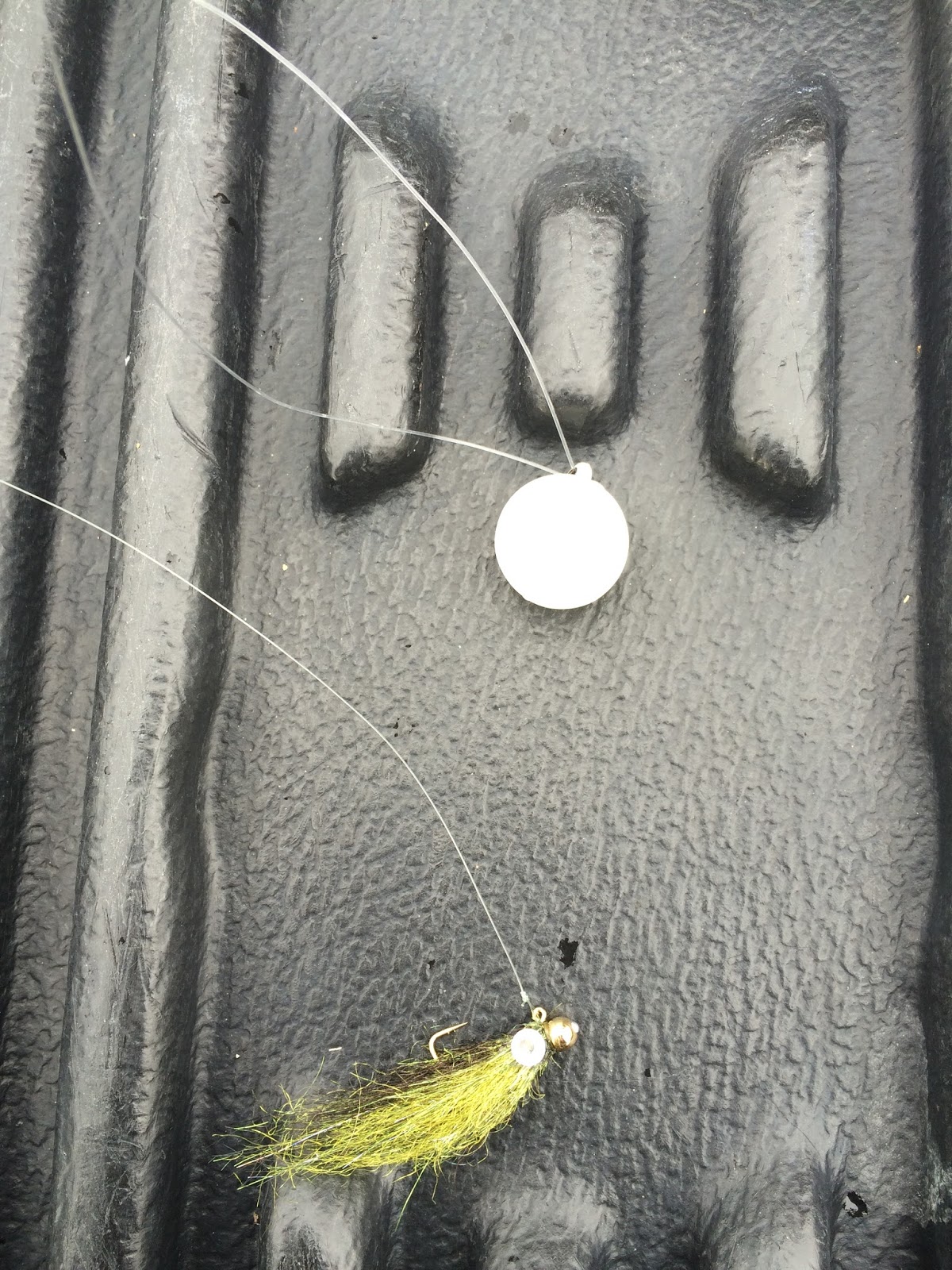
Carp will eat nearly anything in their aquatic environment with the exception of MOST rocks and sticks (I really wouldn't put it past them). However, fly selection and presentation is still very important. The carp in this particular location tend to be suspended in the top 2 feet of the water column. There are also bass, trout and bluegill spawning in the area. Thus I chose to suspend under an indicator; a small yellow bead above a small halloween leech. 
Katie made a short roll cast and we intently watched the indicator drift very slowly through the carp filled water. It only took a few casts before the indicator slowly sunk and Katie raised the rod.
"Does it feel big?" I asked with high hopes.
"Yes, it feels very heavy!"
"I think you've got a carp! I think you've got a carp!"
My excitement was probably greater than hers as I fought the urge to jump up and down.   
 
The 5 weight Helios rod was working overtime, and I like to think it was enjoying every minute of it (my Helios does not discriminate amongst fish species).
 
 
After a great battle and probably too much coaching on my end, we scooped the large goldfish into my tiny net.
  
 
The fish had fought so long and hard that it actually cooperated while we humiliated it with photographs.
 
Katie was very excited to land her first carp, or "Big Nasty" as she calls them, and probably the largest fish thus far in her fly fishing career. She handed me the rod and told me to get another one. Yes ma'm!
 
I casted the fly to a different area on the stream where I had seen a few rise earlier. Several casts later, I was into a nice scrapper of a carp. 
 
This fish tried to wrap me around every rock in the area and in the end, the animal on top of the food chain won (although the gators a few blocks away would probably disagree with that statement).
 
After releasing the medium sized carp, I asked Katie if she wanted to try for another one. She wasn't ready yet so I rolled a cast right back out there. The indicator sunk and I set the hook. I felt the weight of a carp and the battle was on. The carp made a great first run and then came directly towards me. I quickly stripped in my line and leader and was about to see my carp when something extremely unusual breached the surface. Instead of a golden colored fish, my fly was hooked onto a blue, nylon rope. Is that a stringer? The carp continued to battle with all it's might, seemingly un-fazed by the 4 foot hitch-hiker looped through it's mouth and gills. Katie scooped the net under the fish and we took a moment to fathom what had just happened.
 
 
Someone had caught a carp and placed it on their stringer with the intention of keeping and eating it. Somehow the stringer did not remain attached to the bank and the carp swam off with the stringer. My fly had snagged the stringer and here we were with the results.
 
I unthreaded the stringer and released the carp. I felt a bit strange as the carp swam off, thinking about many of my fellow anglers who don't believe in releasing these non-native, often destructive fish. I've killed plenty of carp in my life, but I just have a hard time killing things I'm not going to eat.
 
As we gathered our things and prepared to leave, I asked Katie,"Want to try to catch some of those bright yellow golden trout? I know a place nearby."  
"What?! There's goldens around here? All you had to do is tell me there's goldens and I would have gone to Hagerman just for that!" Katie replied, with the kind of excitement she knew I would want to hear.
Katie had also fished for goldens with me before and not gotten one so she was eager to get a hero shot with one.
 
Before we left though, we picked up some of the garbage that other "anglers" had left.
 
We hopped in the car and headed to the next fishing spot: Riley Creek.
 
Riley Creek is a spring creek that flows right through one of the major fish hatcheries in Hagerman. It's easy to access and gets planted frequently with fish ranging in size from 8 inch doinks to 2 foot brood stock. We pulled up and I put Katie into position to intercept both the rainbows and the albino rainbow hybrids, or goldens as most people call them. With a small tungsten bugger under an indicator, Katie was into a fish in no time.
 
"DANG IT! It's the wrong color!" Katie said in snobby disgust, that a 'normal' rainbow had taken her fly. "I wanted one of the yellow ones!"
"It's a 15 inch trout. You should be happy with that!" I said, while laughing.
Katie practically skated the fish in and then released it. I sat on a log above her and continued to observe as she tried to catch one of the golden trout. Katie was very determined and after a half dozen rainbows, she finally had a golden chase and take her fly, only to miss the hook set. Her next cast placed the fly next to one of the monster rainbows that had been laying next to a golden. From my vantage point I had a great view of this fish and I knew it was over 20 inches. It tipped it's head down as the fly sunk and tried to eat it, but right before it did, Katie stripped the fly. This drove the fish nuts and the chase was on! The fish spun around and began charging after the fly. It was all I could do to remain calm as I watched the massive trout grab her fly. Katie set the hook and the fight was on!
 
Like the carp earlier in the morning, my net was a little small for this caliber of fish. Nonetheless, after a great battle, I was able to apprehend and hand Katie her giant fish.


This rainbow was not the prettiest trout in Idaho, but she measured out at 23 inches.
"Hey, she might be the wrong color, but that's a dandy rainbow!" I told Katie as we released the fish.
"Yeah I'm happy with that one," Katie said with a big smile. "Why don't you try for bit?"
"Ok, I'll make a few casts." I said, grabbing the rod and rolling a cast out to the fish. "Oh shoot! It's a golden!"
"What?! That is stupid! I can't believe you just caught a golden like that! I'm so mad at you!" Katie said with a disgusted look on her face.
"Sorry," I said, laughing.
 
I released the strange looking trout and handed the rod back over. Katie fished a while longer and never did end up catching one of the goldens, but she landed another half dozen rainbows before we decided to move on.
 
One of the locals told us that Shoshone Falls was not worth viewing this time of year because of the low flows caused by irrigation. Since Katie was still eager to fish, we decided to try one last spot for smallmouth bass on the Snake River on our way home.
 
We parked near some railroad tracks and made our way down to the river. Katie made a quick cast and her line went tight on her 4th strip. A 12 inch smallie came thrashing to the surface and quickly into Katie's hand. 
 
The one smallie seemed to be an anomaly, but a short walk downstream revealed a healthy pod of carp milling around in a shallow bay. I switched flies quickly and asked Katie if she wanted to try. She seemed content with her angling adventures for the day, so I gave it a go. Sight fishing for cruising carp can be a challenge, but there were so many carp cruising in so many directions, eventually a fish decided my fly was food and ate it. The fish raced for the main river, grabbing extra strength from the current and doubling my 5 weight over. However, the fish was not a monster, so eventually I won him over.

 
After releasing that fish, I decided I'd put Katie through enough fishing for a couple days and it was time to head home. Even though we had plans to view a few sights, this day had turned into a fishing day.  Katie had landed her first carp and brought in a dandy rainbow trout. She may not have landed a golden, but that may be just the right motivation to bring us back down to Hagerman another time.  


Monday, April 4, 2016

Jig It!


Jig It!


The once emerald green slough was now nearly black, a result of the hundreds of silver salmon taking a pit stop on their journey upriver. This is a fly anglers dream; resting silver salmon are very aggressive. But today was different for some reason. I was guiding 2 clients on the Kanektok River in Alaska. They were making great casts, retrieves and doing everything right. Why weren't we catching fish?
 
I grabbed my fly rod and told my clients to continue casting while I crept around to the opposite side of the slough. The brush and grass were thick and nearly impenetrable; not a place to take my clients, but I wanted to take a closer look at these fish and see their reaction to my clients' flies. I sometimes did this while guiding. A quick observation or tweak in technique could make the difference in having a 10 silver day or 60 silver day. I crawled through the thick brush to the edge of the water. The mosquitos were nearly unbearable, testing my ability to stay focused on the task at hand and keep a calm composure. The silvers were stacked on top of each other, nearly motionless, with glazed eyes as the egg sucking leeches swam past their faces. I unhooked my leech and crimped a split shot on the nose of it.  A small silver lay close to a rods length away from me; a prime candidate for a technique experiment. I dropped the fly off the tip of the rod and began twitching, moving the fly in an up and down motion. In a flash, two silvers nearly 10 feet away charged for my fly, practically fighting to inhale it. The jigging motion had been the key.


Over the years, I've learned how deadly the up and down motion, or "jigging", is to fish. The conventional tackle world has been onto this for years, but fly anglers and manufacturers are just now tapping into this world. I'm going to outline a few tips for catching more trout on your jig-head streamers, and a few tactics for you to use in different scenarios.


The Fly Patterns
 
Large gaudy streamers take most of the hype these days, but I prefer small heavily weighted patterns. A size 10 wolly bugger tied with a tungsten bead-head or cone-head is one of my top producers when jigging streamers, but you can also try using lead or brass eyes for weight. The lead or brass eyes will provide enough weight at the head of the hook to give a great jigging motion, and these eyes paired with a jig hook can be a deadly combination to driving fish wild. A 1-3 inch minnow imitation tied with a jig hook is another one of my favorite patterns to perform a jigging technique with.

Size 10 and 8 Tungsten Buggers
Brass Eyed Minnows  
Jig Head Minnow

Put it under an indicator!
 
 
A stripped leech has and will always be a great technique for stillwater trout, but a leech bouncing at a set depth under an indicator is downright deadly. This is a great way for someone to get started jigging streamers. Leeches are the obvious patterns to use and tie, but fish imitations are very effective as well. Heavy-headed flies like the balance minnow, (see picture below), are great patterns. When fishing a streamer under an indicator, you have a couple of different retrieval options. In both rivers and lakes, the first retrieve is no retrieve at all. A simple dead-drift in the current or drift with the waves can work quite well.

Balance Minnow
 
When the "no drift" technique is not getting the fish’s attention, it is time to add the jigging motion. A light pop or jolt upward and then right back down with the tip of the fly rod is all you need to bring your bugger to life. The pop or jolt is only a 3-6 inch movement of the rod tip, but it brings the fly to life deep in the water column to grab the attention of a hungry fish. One of these pops every 5-10 seconds can be enough to attract a fish, and other times every 1-2 seconds in between pops is needed. When a fish takes, you will see the indicator plunge under the water, but not all the takes are that aggressive. Sometimes the takes may be subtle, merely stopping the indicator instead of pulling it under. So be aware of your indicator's movement, and if the movements of your indicator seem unnatural, then set the hook.


Retrieve Techniques


When stripping streamers, make sure you keep your rod tip low to the surface of the water. It will help you stay tight to your fly, allowing you to detect subtle strikes. You my even keep the tip of your fly rod dipped under the water to maintain full contact with your streamer.

The quick strip is the retrieve I use the most. This is 6-12 inch strips, followed by 1-2 second pauses in between those strips. This is all you need to get your fly performing a jigging action. This retrieve is very versatile and can be used in both stillwater and rivers. It can be fished with floating, sinking, or sink tip fly lines.

When fishing deep runs and drop offs in faster water, I use what I call the "mend-strip". This retrieve only works with a floating line. Cast your fly approximately 45 degrees upstream and throw a quick mend in the line to help your fly get deep. Strip in the slack line as your fly starts to drift downstream, then throw a small mend in the line. This will move your fly slightly, but keep it deep at the same time. These small mends will give a jigging action to your streamer, but won’t bring your fly up and out of the deeper water column. Repeat the small mends while maintaining your fly line slack, making small trips for control. Since you aren't always tight to your fly, a take may register as a movement in the end of your fly line.

 
Jigging your streamers will help you catch more fish, and you can accomplish this by tying or purchase flies with lots of weight towards the front of the fly. Be sure to try a few different jigging retrieves, whether it be subtle or aggressive, to attract hungry fish during different times of the day or year. Sticking with brown, olive, or black in streamer colors is common, but don’t be afraid to branch out to yellow, purple, or white if the day calls for it. Add "jigging" to your book of tricks this year and I know you will catch more fish on your streamers.


Saturday, December 26, 2015

An Early Christmas Gift

It had been several weeks since I had picked up a rod, so when my friend Camron came into town and suggested we try for some steelhead, I happily agreed. At 7 am, I received a text letting me know I would be fishing alone this morning; Camron's wife had gotten sick and he decided losing points wasn't a good idea. So I headed to my favorite Boise River steelhead spot and began fishing. I had to work at 10 am, so 2 hours in the cold rain would be just the right amount.
 
I tied on a green leech and trailed an egg pattern behind it. I worked the water thoroughly in one spot where I have hooked a few fish in the past. The rain began to turn to snow as I waded over to my most productive cut bank. I have taken numerous steelhead in this location, but as the morning faded with no hook ups in this spot either, I decided to try a different technique.    
 
 
I have taken many steelhead under a strike indicator in Idaho and Alaska, so I figured I'd give that a try for my last half hour on the water. I put on a different egg pattern and bobbered up! I walked upstream to a good looking run and started fishing. 
 
My first couple casts indicated I was set at a good depth. I watched the indicator as it gently drifted through the run, bumping the bottom occasionally. I put a little more effort into my next cast, sending my flies into the overhanging tree strategically planted next to the river to eat flies and lures. The worst thing you can do when your flies decide to perch in the trees is to yank them out immediately. The best thing to do is wait, and often times they will fall out on their own, or a gentle pull will free your hook back into the water. I waited a few moments and my egg pattern swung back over the branch and fell into the water. Yes! The indicator drifted downstream and took a dive. I set the hook and the fish took off with the strength of a bonefish. Woooo! This was obviously a steelhead. 


The fish battled for his life as he flung himself out of the water. Up and down the river he went with the strength of a fresh chrome fish, quite uncharacteristic of the usual Boise River type. Again he cartwheeled across the surface of the water, desperately trying to shake the hook. This fish was feisty! After another several minutes and a couple more jumps, he was ready for apprehension. Netting a large fish is difficult enough, let alone when you're by yourself and you have a small trout net. Regardless, patience paid off, and after dancing with the fish for a couple minutes in the shallows, I landed him.


I could barely keep the fish still enough for a photo as he squirmed and tried to kick back into the depths of the river. After a couple quick photos, I knelt beside the fish and thought of what I should do. I normally keep Boise River steelhead, but this one showed so much life and I had no means of processing him before work.

 
Another strong pulse of energy through the fish's body told me he deserved another day in the river. Maybe myself or someone else will be able to catch him again. I let go of his tail and he surged back into the dark cold waters of the Boise River.
 
 
I fished my way back downstream with my remaining 10 minutes on the water. I closely watched my indicator with a fresh sense of optimism. There had to be more steelhead left in this run, I could bump into one at any moment... Just then, my indicator went under and my reflexes couldn't have been faster. I immediately felt tension, telling me my hook had connected with something solid. I waited for the usual slow steelhead shake. I received no such feeling and my hopes faded quickly. I continued to pull back on my rod, and the object I had hooked slowly came toward me until it broke the surface. 


How a hook can find it's way into a tiny tunnel on a rock is beyond me. Some would take this as a sign that their luck is about to increase and a steelhead is waiting for them on the next cast. Others might take it as a sign to stop fishing. Since I had to be at work in 25 minutes, I was forced to adhere to the latter.
 
I reeled my line in and walked back to my truck. I believe any quick trip before work that results in a landed steelhead is a gift, and with Christmas just a couple days away, I considered that steelhead to be an early Christmas gift.
 

Tuesday, December 22, 2015

Too Much of a Good Thing

 
When it comes to hunting waterfowl, wind is your friend...at least that's what I always thought.
 
My good friend, Jim Bottorff, invited me to hunt with him on a small piece of private land with a flooded field. You'd have to be nuts to refuse an offer like this. Flooded fields to mallards are like lily pads to bass; you can't keep them out. So of course I took him up on his offer and at 6 am we were driving in the dark to the field.


 We readied our gear and set the decoys.
 
 
From our spot in the blind, the wind was blowing at a steady 10 MPH, directly at our faces. This is not ideal but fairly easy to remedy on a small body of water. We set the decoys in a U shape at 40 yards away. This way the ducks would approach over our heads and choose to land between us and the decoys. Jim informed me the importance of keeping a large hole for the ducks to land in breezier conditions.
 
With everything set in place we sat back and enjoyed the beautiful sunrise.
 
 
The first ducks to come in were a pair of wigeons. They descended exactly the way we wanted them to. 
"Let's take em!" Jim shouted and we rose to accomplish our task.
Both birds fell and Bear, Jim's chocolate lab, charged out of the blind to retrieve them.
"Good girl, Bear!" Jim praised, as Bear brought the ducks into the blind and into Jim's hand.  
 
 
We intently watched the skies for more birds. Occasionally we'd see a group approach and veer off without giving us a second look. I started to express some concern as the morning progressed and several groups gave us the "cold wing". It seemed the wind may be affecting them in a negative way. Jim kept up his optimism however, and before long, another small group circled and a drake mallard descended into the decoys. Jim rose and shot, giving Bear another bird to carry back to the blind. 
 
 
We waited a while longer before any more birds showed interest in our location. There just didn't appear to be many birds in the area. Jim and Bear scanned the skies intently.
 
 
The hunting slowly began to pick up as the morning progressed, but so did the wind. Another gullible greenhead hit the water and immediately was blown back towards us, giving Bear a short retrieve. 


One by one we began to add greenheads to our stringer.


As fun as it was to get a duck every half hour, we wanted to see more birds working our decoys. The wind had picked up even more and was easily blowing 15 MPH, with gusts over 20. Our small, flooded field looked like the ocean with 3 foot rollers. Not exactly enticing to birds looking to feed and loft out of the wind. 

 
"I think we better move the decoys out further. Maybe another 15 yards. When the wind is blowing like this, it's always best to give them plenty of room to land. They don't like being cramped." Jim said with certainty.
"Ok I'll go move them. Get ready, because as soon as I step out of the blind, the birds will start pouring in!" I said, referring to the dozens of times that has happened to me.
 
No birds approached as I was moving the decoys, but as soon as I got back into the blind, a pair came in and met their fate. Bear made a couple of wonderful retrieves.


The next hour produced several more birds. It seemed that moving the decoys had paid off. Birds were giving us a little better look.  


It was nearly noon now and we had 9 birds on our stringer. We were talking about calling it a day when a single mallard snuck in and tried to land. We both rose and shot, bringing down a hen. We decided that was a great place to end our hunt.
 
 
We packed up our gear and the decoys, and laid the birds out for some photos. It had been a fun hunt, but not a terribly easy one. The wind had been too strong, changing our flooded field from an inviting duck oasis to a hostile desert. By moving the decoys further out and opening up the "pocket" we made the ducks feel a little better about landing. I always thought wind was a good thing, but on this day, it was too much. In super windy conditions, remember to open things up a bit and you'll likely see more success. 

Tuesday, November 10, 2015

Mixed Bag


My first duck hunt of 2015 occurred much later than I would have preferred. I knew I had missed the bulk of the early season action but I just had to go. The hunt was a successful one, but it reminded me of two important lessons I've learned since I started hunting waterfowl.
1.) Timing is critical
2.) Be persistent
 
If I've learned anything about hunting waterfowl over the years, it's knowing WHEN to go. My hunting buddy and I started hunting waterfowl in college. We had no mentors and no clue what we were doing, but we had time and the desire to figure things out. Slowly over our 5 years of college, we became more and more successful until we were consistently bagging birds. We learned the pattern of the birds in Southern Idaho throughout the season. Here is a simple breakdown:
  • The first 2 weeks of the season are generally good for local bird action
  • Early November until close to Thanksgiving is what I call the "mid-season lull"- most of the locals are gone and the Northern migrators have yet to reach our area
  • The Northern birds show up near Thanksgiving and hunting is fantastic until close to January, when many of the birds become quite educated
Weather also plays an important role:
  • A sunny day before or after a storm is generally a good time to go
  • If it's snowing, it's almost always good- birds have to feed all day in conditions like this
  • Wind is generally your friend- it moves the decoys and tells you how the birds will approach
*Of course none of this is absolute and scouting is always the best way to ensure success. 
 
Which brings us to our hunt. We had no time for scouting, so I was relying on past experience. The weather was favorable; cold, windy, and a storm had recently moved into our area. This told me our chances of a good hunt were higher than if the weather had been "stale" and no wind was present. I met my good buddy, Jordan at 4:15 am, and we set off in the light rain to my favorite early season pond.
 
It apparently had been raining a bit harder and longer at the duck pond because the parking lot was soup!
 
 
We set up on the pond and waited for legal shooting light. Our anticipation was high as we thought of the potential success we might have.
 
Legal shooting light came and a few groups birds were flying. Near 8:30 am, a single green winged teal coasted into the decoys and met it's fate as Jordan rose and took his shot. Jordan waded through the muddy water and retrieved the single.

 
The morning slowly crept by as we watched the skies empty themselves of birds. So far we hadn't seen a single mallard, only a few buffleheads and teal.  
 
 
As we sat in the bulrushes, waiting for the action to heat up, the truth slowly began to creep up on me; it was the mid season lull! I had missed the early season action and all the local mallards had been either shot or forced to migrate out of the area. 10 am approached and we only had the single teal to hand.
"What do say, Jordan? I just don't think its going to happen today. We haven't seen a single mallard."
"Let's give it another half hour."
"Ok, I'm fine with that."
Shortly after we spoke, a single duck approached low and fast over the water until it glided into the pocket in the decoys. Jordan and I both rose as the drake redhead ascended and attempted to make it's escape. BOOM! Jordan's shotgun went off and the redhead lay dead on the water.
 
 
"Well, I guess it's a good thing we didn't start picking up the decoys." I chuckled, as we both left our hideouts to check out the beautiful specimen.
 
A little while later, a decent sized group of green winged teal bombed the decoys. Like bottle rockets in a swirling wind, they split up and rocketed off in about 5 different directions. The birds gave us only a second to pick a target and make our shot. I'm not sure how I managed to do it, but just before one coasted over my head and disappeared behind the bulrushes, I pulled the trigger and dropped a drake. As excited as I was to have gotten a bird, I was slightly dreading the retrieval of that bird. Behind us lay a large forest of thick, swampy bulrushes.    
 
 
Jordan and I both trudged through the tall, thick, impenetrable forest of bulrushes in search of a bird the size of an iPhone 6. After nearly 10 minutes, the little guy magically appeared, nested on top of the matted bulrushes.
 
 
We returned to our seats, satisfied with the action the last 30 minutes had provided for us. We sat a while longer and stared at empty skies.
"Shall we give it another 30 minutes?" I asked Jordan.
"Sure. It's a good thing we hunted that last half hour. We've got 3 birds now."
 
Close to 11 am, a nice drake American wigeon descended into the decoys, providing us with another bird to carry home. 


Shortly after, a "booner" of a drake gadwall met it's fate to Jordan's deadly accurate shotgun. 

 
The action was not fast and furious, but our pile of birds was building.
 
Across the pond, a group of birds approached low and fast. They appeared to be teal, but as we rose to shoot, it became apparent they were ring-necked ducks. BOOM, BOOM, BOOM, BOOM!!!! Three birds lay on the water, and the bird dogs(us), went to retrieve them. 

 
We sat and waited until 12 pm before deciding to pack it up. We grabbed the decoys and took our stuff over to the pond bank. As we sat and watched the pond before our march back to the truck, Jordan and I discussed how important it had been for us to BE PERSISTENT. It's easy to give up and believe it's just not going to happen, but sometimes, the birds just aren't flying until later in the morning. If we had packed up at 10 am, we would only have a single teal to show for all our effort. When hunting over water, I've found that the action can be anywhere between first light and 2 pm. One hunt in particular, it was all I could do to sit and wait until 11 am. Sometime near 11am, a group of 100 corn-stuffed mallards descended into the decoys, starting an hour of mallard madness in which 2 of us finished with 12 greenheads.
 
Despite no scouting and a hunt at the "wrong" time of the season, we were successful because we were PERSISTENT. Our stringer was certainly not a pile of greenheads, but we finished with 8 ducks that will eat just fine!