Tuesday, September 25, 2018

Float Tubing in the Mountains


September 2018
As fall approaches, the evenings cool and the days grow shorter, trout begin to move back into the shallows of lakes and reservoirs. These seasonal changes stir in them an instinct to pack on the pounds for the coming winter. Minnows and leeches become a prime food source, and if they're available, trout will even feed on dead Kokanee salmon. 
Katie and I planned our next adventure to put us in the Central Idaho mountains chasing trout in our float tubes. This particular reservoir was one I hadn't fished in years but had fond memories of. We chose to camp and fish where the river entered the reservoir. Google Earth revealed some great drop-offs and a distinguishable river channel; key features to focus our effort on. 
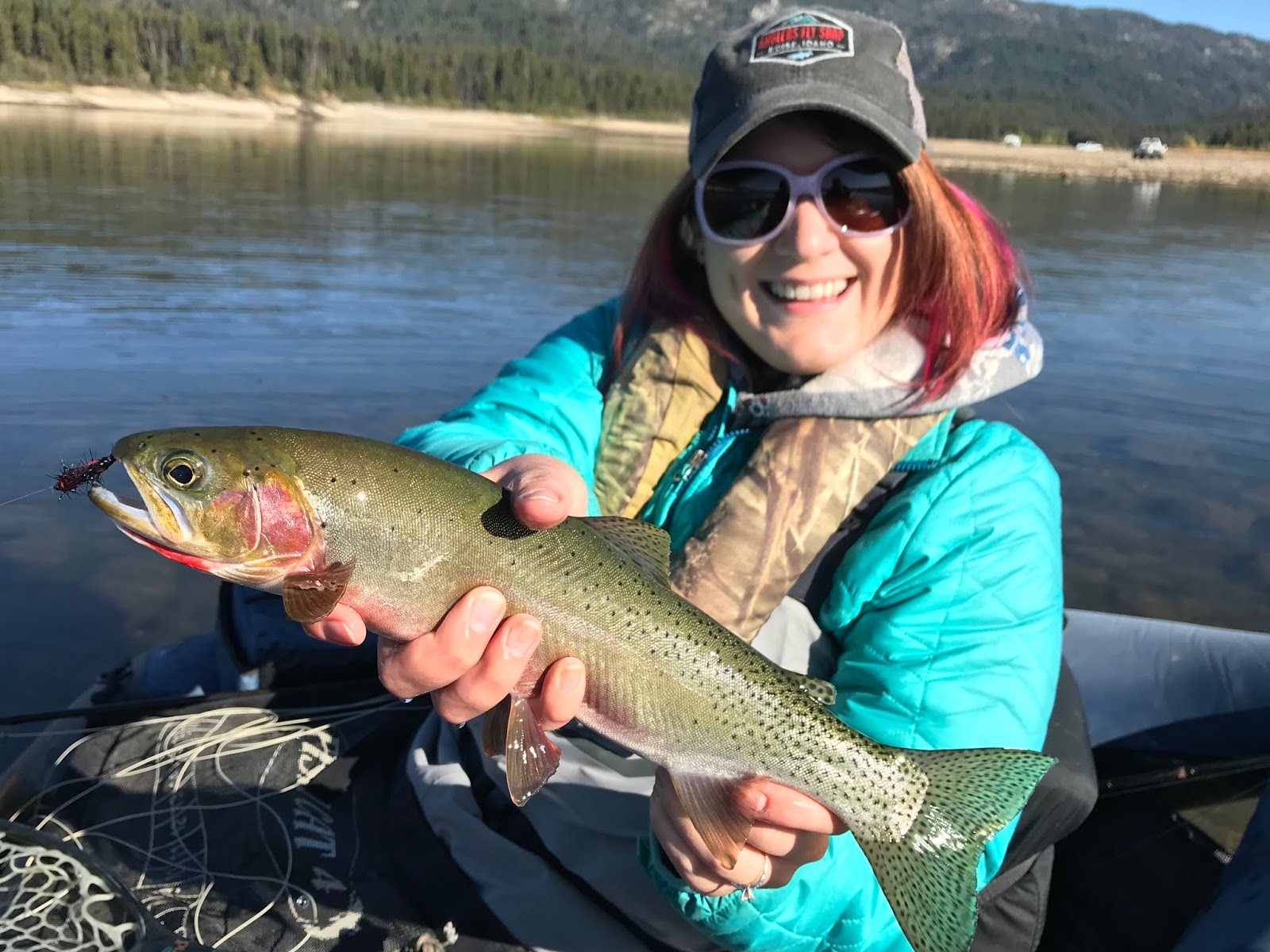
The first day of fishing started like most trips to a lake; calm, glassy water with fish rising everywhere. Once our float tubes touched the water, however, the wind kicked up and waves started lapping against our tubes as we kicked away from the shore. It's almost comical how many times this has happened to me and I suspect many anglers can relate. Regardless, the water was very clear and the sun was out, showing us exactly where the river channel was. We trolled our flies over to the river channel, tethered our boats together and anchored near the edge. I started casting a flesh fly and Katie a leech. BOOM! My line tightened and I set the hook on the first fish of the trip. A chunky cut-bow darted about in the clear water.
After releasing the fish, we continued casting and stripping with no success. Rather than moving on to another location, I reeled my line in and looked over at Katie.
"It's bobber time!" I said, grabbing the other rod in my boat already rigged with a balanced leech and a large yellow strike indicator.
Katie chuckled and grabbed hers as well. 
I started with an olive and brown leech and Katie with a halloween.
It couldn't have been more than 20 seconds before Katie's big pink bobber dove under the surface and she heaved back on a nice fish. This one was a gorgeous cutthroat.
The next several hours were filled with a lot of nice fish: rainbows, cutthroat and cut-bows. The trout were cruising the edge of the river channel. When one spot slowed we would re-anchor 20 yards away and resume catching fish. The chop on the water was also helping our flies dance under the water as our bobbers rose and fell with the waves.  
"Gosh, this topography is awesome!" I said in a humorous way, pointing to the steep drop-off in front of us leading into the depths of the river channel. "It's all about that topography!"
"You're silly," she laughed and rolled her eyes in the, 'I married a nerd' sort of way.
"Oh, this topography!" 
Topography became the joke of the afternoon, and I beat it to death. But you couldn't argue with the success we were having because of it.
We kicked back to the truck near dinnertime, finishing up a stellar afternoon of fishing.

The following morning we rose to the chirping of bald eagles. The skies and shorelines were full of them, as well as osprey, vultures, sandhill cranes and herons. Today we would try a different spot. Google earth showed a clear drop off that extended out into the lake a couple hundred yards. We kicked off from shore, this time trolling a flesh fly and a leech. I hadn't gone more than 30 yards from shore when my line went tight to a fish. I brought in the cutthroat and released it.
Katie was on next.
We continued to troll along the edge. To my right it was 4 feet deep and to my left, 10. We continued to pick up fish here and there.
We eventually lost track of the drop off and turned around, trolling our way back. We began picking up fish once we found the edge again. We decided to anchor up and try the bobbers for a little while. It worked like a charm, despite the calm water. From my experience, fishing a balanced fly under a bobber works about the same whether it's calm water or choppy. 
We took a few hours off from fishing to eat lunch and go for a hike. But at 5 pm we were back on the water to see what the evening held. We anchored our boats near the river channel and caught several more rainbows, cuts and cut-bows to finish out a great day.
The last morning of our trip we rose bright and early to catch the morning bite and the calm water before it was time to drive home. We tried trolling the drop off before kicking over to the river channel. On the way over we passed through some deep water with large pine stumps scattered about. My line quickly tightened to a strong fish! A silver flash came from the depths. What is this? A black, freckled, silvery fish came thrashing to the surface. A chinook salmon! I scooped the 17 inch fish into the net. Fish and game has been planting chinook in many reservoirs in Idaho over the last few years and in some locations they are thriving and reaching sporting size. This was the largest land-locked chinook I'd ever caught, but surely more to come in the future.
We released the fish and proceeded to the river channel. The calm, clear water enabled us to find little pockets of old creek channels, stumps and holes the fish were using adjacent to the river channel. The action was consistent, however today our hooking success was lacking. 
"Honey, you got one!" I shouted with excitement as I watched her bobber dive.
Katie heaved back on the rod, several seconds too late. "Darn-it! I was looking at the eagles! Oh, you've got one!"
I quickly looked at the end of my fly line to see my bobber one foot under the surface. I yanked back in a futile attempt, seconds too slow for a seasoned trout. "Darn-it! I was paying attention to your bobber!"
We both laughed. After re-casting, the same thing happened again.
"Stare at your own bobber!" I said, frustrated that we kept missing fish due to looking at each others bobbers instead of our own.
Even after we committed to looking at our own bobbers, something else would distract us, causing us to miss more fish. At least we were having fun. Despite the poor hook up rate, we managed to land numerous fish, including this nice rainbow.
We drove home with big smiles on our faces. The fall can be a fantastic time of year to get the float tubes back out, and most of the time, you'll have the whole lake to yourself. Concentrate your effort on river and creek channels, drop offs and flats. Locate these topographic features with a depth finder, google earth or simply clear water on a sunny day. Find these and you will likely find the fish. When things seem to slow down, remember: put a bobber on it!


Sunday, September 9, 2018

Floating the South Fork

Fishing with Terry Kowalis July 28, 2018

I met Terry at his house early on a late July morning. Terry and I had not fished together since last summer and neither of us had floated the South Fork of the Boise this year. I threw my gear in his truck and we took off for the South Fork.

As we approached the Cow Creek bridge, it was apparent that Mormon crickets were a possible food source. Large black crickets peppered the road and the Cow Creek bridge. 
"Should we toss a few in and see if they're eating them today?" Terry asked with childish delight.
"Sure!" I responded, already envisioning the likely results of our test.
We both grabbed a cricket in each hand and walk onto the bridge. The river left bank always held a few fish and we knew right where they lived. Splat, splat. Two dark crickets hit the water hard but floated in the surface film down the bank alongside the willows. Shhlurp! Shhlurp! Two large rainbow trout made quick work of the chunky crickets. Terry and I looked up at each other with wide eyes.
"Let's float this section first!" Terry said.
"I think that's a great idea!" I responded logically.
We dropped off the shuttle bike at the take out and launched the boat at Cow Creek. We rigged the "big bug" rod with a Mormon cricket pattern and another smaller rod with a grasshopper.


We pushed off from shore, myself in the front seat ready to fish first. I began casting to the willow lined banks, my fly drifting in and out of the shadows. Shlurp! A large golden rainbow came up and devoured my fly right where it should. I brought the fish in and quickly released it. We had only drifted downstream a couple hundred yards.
"Ok Terry, you're up!" I said, setting the rod down in the ready position, 30 feet of fly line out of the reel.
In Terry's boat we use the 3 strikes you're out rule and the one fish landed, swap rule. I landed my fish so it was now Terry's turn at bat.

Terry worked the banks, threading his fly in and out of the bushes. It wasn't long before he was into a nice fish of his own.


We swapped again, this time I missed 2 fish before connecting with the 3rd, a rainbow at about 18 inches. The fish kicked the fly at the boat; a perfect release. Terry was up again. Terry and I made 2 swaps before we reached the take out of our short float. 
"Let's do that one again!" Terry said, taking into consideration our success and earliness of the day.
"Makes sense to me." I responded, as I held the boat so Terry could exit and make the shuttle.

I had always wanted to fish streamers on the South Fork from the boat but had never committed to doing it. While Terry was running the shuttle I rigged up my other rod with a money minnow and began casting it from the shore at the take out. My sparkly minnow danced in the water. I was only checking how the fly looked in the water when a large flash darted at my fly, inhaling it. I set the hook and fought the large rainbow from the boat. Seems to work pretty well. I netted the fish just as Terry returned with the truck and trailer.
"Fish took a streamer. I think I'm going to try this on our next float." I chuckled, as I released the fish. 

We launched the boat at the same spot as before. Once again, the fish were eager to rise to the cricket pattern. We lost a few flies in the trees and tied on a large purple chubby instead of a cricket. It also worked confirming my theory that these fish will eat almost anything big and buggy when placed in the right spot with the right presentation. 


I landed a chunky rainbow that had a long synthetic line coming out of it's throat. I have caught steelhead with these before and was informed they are some sort of tracking device. I could only assume that's what it was. If anyone knows, please let me know.


We finished up our second brief float shortly after lunch time. Our next float would be from the village down. We made our shuttle and by 2 pm were were launching at the village put it. We made our way down the river. Yellow sallies could be seen fluttering around, so we tried a yellow sally fly. It worked, producing a small scrappy fish.

We entered a side channel Terry had named "Muggers". We pulled into a back eddie and anchored up, watching for rising fish. Sure enough, fish rose here and there. We tied on a pink Albert and began targeting rising fish. It didn't take Terry long to connect with a nice rainbow. 

The current seam we were fishing was very slow, causing the trout to cruise in and out of the back-water instead of holding in the current. This made it tough to anticipate where the trout would be and therefore where to present your fly. Eventually I timed a cast right and was rewarded with a nice trout.

After playing with these rising fish for probably too long, we pulled the anchor and drifted down to another spot looking for pink eating trout. Once again, a healthy population of fish were feeding on the surface. Terry and I each connected with several fish at this location before moving on. 

As we drifted down the river, it was obvious this stretch received the bulk of the fishing pressure. Not only did we see a lot of boats, but the fish were not eager to rise to our attractor patterns like down below. Our solution: a Ken Held hopper. As realistic of a hopper pattern as it gets. This 1 hour long tie can fool both fish and humans alike. Armed with this fly, we finally started seeing looks from the fish. 

Fishing was still tough until we made it past the common take out location. Like magic, the fish started looking up again and Terry responded with a dandy fish.

We each landed a few more fish before we reached our take out spot. It had been a long but fun float down one of my favorite rivers. With the boat on the trailer, we drove over the Cow Creek bridge to head home. Terry slowed as we reached the other side.
"Shall we grab a couple more crickets and feed the fish before we leave?" Terry questioned.
"I was hoping you'd say that..." I responded with a smile.   


Thursday, August 2, 2018

Lake Cascade, Like Yellow Perch, only Bigger

Katie and I had been hitting the fishing pretty hard in the spring of 2018. Crane Falls, Owyhee and Brownlee; all overnight trips and all great fishing. My mind was already thinking about the next place I wanted to fish: Cascade Reservoir. World famous for it's trophy perch, Cascade is one of the few places in the world where you have a shot at catching a 16 inch fish. Until you see one that size, you won't understand.
"I was thinking we should try Cascade this weekend," Katie suggested one evening. 
My head quickly cocked to the side. Did I just hear what I wanted her to say? "I think that's a brilliant idea!" I responded enthusiastically. "You are one amazing woman!"
"Let's try to catch some of those perch!" The angel next to me said.
"I've been wanting to try that.."

I conducted a little research, talking to guys who have fished the reservoir. Cascade is a large formidable body of water, but with some advice, I had narrowed down our fishing options to a couple locations. After getting off shift at the fire department, I rushed home and packed up the truck, leaving Boise by 10AM. Katie's brother Trevor was also going to meet us up there.

Upon arrival at the lake, we found a nice campsite in a developed camp ground; something Katie and I are not used to. We set up camp and quickly made friends with our neighbors across the way: a fellow fire fighter! He and his wife would be there for a whole week and they had brought their boat. We discovered they were fairly experienced at fishing Cascade. They gave us tips to find the fish and even invited us out on the boat in the morning, an offer we couldn't refuse.

We got our gear and boats ready, pushing off the bank just in time for the evening bite. 
"I don't think this tape is big enough for the fish I'm going to catch!" Katie said, referring to the stripping apron on her float tube.
"Oh really? You are so spoiled!" I laughed, and then thought about all the large fish my wife had caught this year. She truly was spoiled. "We'll see about that!"

Perch tend to hang in deeper water than most fish we're used to targeting on the fly rod, so we set our balanced minnows at about 15 feet and began to slowly troll and jig them at the same time. Katie and I kicked along, probing the depths for perch, or whatever wanted to bite. Tall aquatic weeds had begun to grow, snagging our flies when we wandered too shallow.

I began to kick into slightly deeper water and away from the weeds when my indicator sunk and I felt some resistance. I set the hook and felt a fish squirming on the other end. The fish didn't put up much of a fight, telling me it probably wasn't a trout or a smallmouth. Could it be a perch? A large, yellow shape with dark stripes materialized beneath my boat.
"Honey, I got a perch! And it's huge!" I shouted to Katie, who was about 50 yards away.
Katie kicked over to take a picture.
"Look honey, it's like a perch. Only bigger!" We both chuckled as I held up the large specimen.
I measured the fish on my stripping apron: 15 inches!
I placed the fish on my stringer and we kept on fishing.

My next fish was a rainbow trout. Only 14 inches and diseased looking, it made it back into the water without a picture. 

By 7 pm we had still only caught the 2 fish. This perch fishing may be a bit more challenging than we hoped for. We were almost back to where we launched the boats when Katie tied into a fish.
"It's a perch!" Katie said, netting the fish.
"Looks like another big one!" I said, getting ready to take a picture.
Katie held it up for a photo; another dandy specimen, about 14 inches.

Trevor showed up and we went back out to fish until dark. Again, the fishing was not superb. We tried deeper water and shallower water but we just couldn't seem to find anything consistent. About a half hour before dark I tied into another 2 perch right by our launch spot. Trevor also caught one that was a monster at 17 inches, finishing up a fun but tough afternoon of fishing.


The next morning we went out in the boat with our fire fighter friend. He took us to a couple spots where I landed a few more large perch. 
Once again the fishing was slow and no one else caught a fish. By 10 am we were back to camp and ready to hit it hard in the float tubes.
"It's as hot as the dickens out here!" Trevor exclaimed, as we pushed off the shore to fish for the afternoon.
We laughed at Trevor's comment, the start of an afternoon overusing the expression.
"These perch are as big as the dickens in here!"
"This fishing is as slow as the dickens!"
"I'm as hungry as the dickens!"
"This water is as cold as the dickens!"
If fishing was going to be slow we might as well have fun while doing it. 

By dinnertime we had landed a couple more perch and some decent smallmouth. One bass was 19.5 inches.


We also stumbled upon a couple pike minnows. Between wanting to kill them for ecological reasons and never have eaten one, we put both on the stringer to eat later. This trip was turning redneck... 

While Katie warmed up our planned dinner, Trevor and I set the pike minnows on the grill over the fire. We had no foil or seasoning to go along with them, so what we would taste would be truly squawfish. We also grilled up a couple hotdogs to go along with them. Hotdogs and squawfish, the phrase sounded so gross it made us laugh. Once the fish began to fall apart, we scooped them onto a plate and dug in. The pale, bland and slightly fishy meat reminded me of a fish I haven't eaten in years: trout. It was edible but less than exciting. It was also full of small Y-shaped bones that appeared to be in every bite. We ate most of the 2 fish and burned the remains. I can now check eating squawfish off my list. If you think trout taste good and like picking bones out of each bite, give pike minnow a try!
A storm was rolling in and we debated on whether to go back out after dinner.
"Let's just stay in camp... but on the other hand, the wind on the water will give our flies some great action."
"Let's just go out and fish... but on the other hand, we could get struck by lightning."
"Let's stay in camp tonight... but on the other hand, this is our last evening to fish. What if the perch really bite well tonight?"
We all joked around with the phrase, "but on the other hand...". It reminded Trevor and I of a guy we used to work with in Alaska who over-used the expression.

After some debate we decided to go out and fish. It was a good thing we did, because we ended up catching several more perch and bass.


The following morning we went back out in the boat with our friend. We tried a new location and it ended up being fairly decent. Our friend landed a few perch, a trout and a bass, while I ended up with one perch.

We packed up camp and headed home with several large perch fillets in the cooler. I am glad we gave Cascade a try, giving us a new place to fish. We never saw another fly fisherman and ran into very few other anglers. Although fishing was tough, we tried a new body of water and were successful in finding a few of our targeted fish. We all had caught the largest perch in our angling histories. We will surely return to Cascade in the future. Like I said, until you see a 16 inch perch you won't understand. They are like perch, only bigger!